Wednesday, June 3, 2015

Reflection

accurate depiction of me and shopping
After analyzing media in the world today I realized that it impacts my life way more than I previously thought. The media which I consume daily on my computer, my TV, and especially my cell phone impacts my values and what I perceive about reality.  I realized that I probably don't have one original thought in my head, whether it is about how to achieve greatness, or how to be fashionable, etc...because all companies that market, have monopolized these ideas in pop culture and sell them as a package with their product.  Recently I went shopping for a birthday present, and I got two items for my friend.  I knew she liked flowy types of cardigans so I got her a kimono.  I had trouble pairing a cute item with it, but ended up getting a floppy hat to match it.  This look as marketers sell it is called "boho" and is a very fashionable style presently.  I started to realize the main reason I think these two items went well together was because of how this "boho" style is advertised on attractive women models who have handsome men around them, and who look like they have a fun carefree life. 

My interactions with the media have changed quite a lot.  I am definitely more media literate.  Whenever I see advertisements I think of the multiple advertisement techniques the company uses with its ads.  I see who the target audience is and think of the appeals that might attract the target audience.  I can also see now , especially for clothes and shoe brands, what appeals to me and how they make me feel.  I realize that it is all just a trick and that buying specific types of clothes won't make me any cooler, because if I want to be fun and social and live life carefree, I have to change my character, not the clothes I buy or the shoes I wear.

I have always been a frugal type of person who like to window shop and look at new products through a window, but now instead of feeling a hopeless desire to attain all these products I don't actually need, I question my intentions on why I want the product so badly.  It always leads back to the implicit and explicit messages that the companies send through their product.  Sometimes seeing the unrealistic ideals paired with, for example a bracelet or, a shirt, I am able to talk myself out of wanting something, just long enough for me to escape an NOT  buy useless items.  This example is why its IMPORTANT TO BE AN EDUCATED CONSUMER!  In short you wont buy too many useless items. 

This blog was really fun and I really learned a lot from scrutinizing media messages to society.  I hope that I can continue to use the traits of a critical thinker even after this log is over.

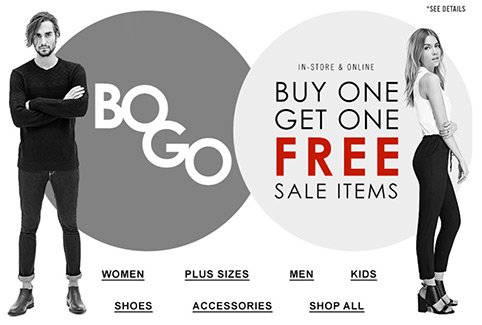
BOGO my favorite word

I absolutely love to shop.  Yesterday I went to the mall and I was overwhelmed with happy sensations from seeing all these wonderful items of clothing and accessories that I could possibly buy.  WAIT  a minute...there's something wrong with that.  I should be getting warm fuzzies from caring loving people...not clothes and accessories. 

Even though I had warm fuzzies I also had a sense of anguish because I realized that there was no way I would be able to get all the things that I liked.  This cognitive dissonance really made me feel horrible inside.  Usually the way to resolve this type of cognitive dissonance is to buy everything that you want without worrying about money, which is what companies want.  Unfortunately for the companies, I have a little more common sense than to waste all my money on clothes when I know I have more important things for that money to go to.  Thank goodness for this media blog too!

I think I fall too easily for marketing strategies and I would definitely be in the target audience of most companies.  In general, the appeals the attract me the most is the need for attention, the need for affiliation, the need for autonomy, and the need to achieve.  I know that's a lot of appeals, but as a teenage girl who wants to fit in, but also wants to stand out, there's no doubt that the list is going to get pretty long. 

Sunday, May 31, 2015

Taco Bell- Be a Man

At first when I was watching this taco bell ad I thought it was a ford commercial, but then I realized that the narrator was being too direct. 


In this commercial, a deep voiced man is telling the target audience--males-- that in order to be a man they must drive a big truck, they must have rippling abs and spray cologne on themselves, they must lift big, be surrounded by women, swing hard, wear specific clothes, and shave etc...However at  the very end clip three men who are watching this so called commercial, are eating the triple stacked steak stack on flatbread from taco bell.  The narrator voice changes to the regular taco bell guy and he says if you need someone to tell you to be a man than you are not the type of guy to be eating this steak sandwich.

It's funny that after watching that whole commercial of how they say you need to be a man, Taco Bell did the exact same thing.  They appealed to the desire for masculinity and to achieve because for men, to be manly is winning as media portrays it.

Once again media is sending the incorrect message that men have to be hyper-masculine.   They even go  on to  indirectly insult men that need to be told these things or who don't eat Taco Bell. One of the reality assumptions in this video is that real men like lots of steak. Once again incorrect. This ad preys on men's insecurities about how to be manly. Although I don't think any man will take this commercial to heart, the messages it I sending to society will affect how they and even how young boys will think in the future.

Beyoncé is Queen

 
Every magazine she graces, every new song released, it's no doubt that Beyoncé can do no wrong. I have never seen an article or entertainment news  video, shaming her body, her fashion, or her choices.  And it hit me, when did Beyoncé become this embodiment of perfect? I have never dislike Beyoncé and  I think she's a talented artist, and a beautiful woman with a seemingly perfect life.  But I realized that this OPINION  of Beyoncé  started becoming a fact and  I questioned how the role of media played a part in making  Beyoncé this 'perfect' being. 

The media portrays Beyoncé as perfect, so undoubtedly the outcome is that majority of society finds her to be perfect too.   

One of her songs is called "pretty hurts". It's a very empowering song to women  and tells of the  pain that  girls and women go through  because of the standards of society. This connects with the documentary Missrepresentation because  women who suffer from objectification  are most commonly women celebrities.  Beyoncé, although found favorable in mainstream media's eyes, has not escaped the  common objectification of women. 

Beyoncé who has many young girls as a part of her fan base was the perfect singer to send the message on how hard it is to be girl.  It teaches an important message that not every girl is perfect and that its impossibly hard to try and live up to a perfect that we can never reach.


The World of Advertising for my Dad

Being in critical thinking has really opened my eyes to the world of advertisement and how companies like to mess with our psyche to make us think we need their product.  Advertising has become something very underhanded.  Marketers prey on our fears and our desires and I wholly believe that it is advertisers that control society today. 

Just today I was talking with my Dad about getting him  a new phone since his malfunctions a lot.  It never seems to work when we need it to.  He wanted to get something like the Samsung galaxy note 4 phone and when I asked him why, he came up with the reasons behind his wants.

His main reason was because he wanted to be able to write things down with his stylus, which I found to be an absolutely ridiculous reason.  I told him that he could write things down in his phone by typing it into the memo or reminders, or his calendar, but he really felt the need to use a stylus and quote on quote "notepad"--the phone itself. 

I know that my Dad is forgetful and having a phone with a stylus and notepad is not going to make him any better at remembering to do things.  However, the company has sold this idea so well that a person who has this phone will be organized, that my Dad has fallen into the consumer trap. 

We will see what new phone he ends up getting by JUNE. 

Tuesday, May 26, 2015

Getting a Little...Old

I found this hilarious jab done by Huffington Post at Abercrombie and Fitch, the infamous teen retailer.  After the CEO made a remark about how he didn't want fat people shopping at his store in 2013, the sales at the store dropped, not surprisingly.  I was a huge fan of Abercrombie in 7th and 8th grade.  Still to this day I would buy clothes there, but usually I find it either too expensive or not unique enough.  Abercrombie, who features topless men, and scantily clad women, on the cover of their bags and on most of their window/online advertisements, has always done a great job in making the clothes seem attractive. It uses transfer association because consumers would feel that they too could be just as sexy and attractive as the models, or they could also snag a handsome man if they wore the clothes. 
Abercrombie did a great job in making me feel like less of a person because I wasn't skinny enough to fit a size zero or I was too short and the pants could never fit properly.  Abercrombie is one of the many media influences on young girls and how they perceive their bodies. By excluding sizes such as XL they set up a barrier for what was "cool" or socially acceptable, since Abercrombie was a big deal (at least for me in middle school). 

I would have to admit though, that the way Abercrombie advertised to teens was very effective since everyone wants to be apart of the "in" group-the "cool kids". 

With new retailers, and also less customers, who have been off put by the CEO and the message that Abercrombie sends to young girls and teens, Huffington took the opportunity to display a tangible representation of the store.  This old store is not the newest coolest thing anymore. 

Monday, May 25, 2015

Who Makes Cool?

So recently I have been thinking about buying some new clothes since its summer and it's been ingrained in my mind that a new season equals buying new clothes.  As a critical thinker now, I have been very cautious with my urges to buy things in general.  I can now see the appeals and the ad techniques that advertisers use. However, no matter how much I can identify the messages and techniques used, I realize I still have the desire to buy new things.


Now that I have already established that I want to buy summer clothes--swimsuits, shorts, tanktops etc...It's important to talk about why I feel the need to buy such new clothes, when my closet is stuffed with clothes that still fit me perfectly (since I stopped growing about three years ago.) The media sends messages to me everyday advertising the new coolest things and as more and more people get this new, cool thing, I feel more pressure to buy it as well.  The pressure from the media to buy new things is a heavy load, but the pressure I put on myself is even harder.  I made a revelation after watching Missrepresentation, in my last post. Put shortly I realized that girls feel pressure to look good all the time.  In order to look good we feel that we need the coolest stuff to wear, and look the prettiest, and follow the latest trends. In the documentary, Merchants of Cool, advertisers said that it was the teens, the consumers who "invent" what is cool, but that is not the case. 

To a certain extent it is the teens who are dictating what is cool and what is not cool, but as long as advertisers keep making the same types of clothes and advertising them with pretty models who are surrounded by friends and boys, It seems that advertisers actually have the power. 

Scrolling through the endless wonders of online shopping websites, I saw many repeated styles.  For example crop tops, or kimonos, or another one of my favorites, flowy shorts.  As of right now I find those styles to be trendy, but these styles have been blown up by the media so much already.  And STILL people are buying these trends.  The minute that advertisers bring out the next new style, girls will jump on the chance to buy  it.  As a consumer who wants to buy new clothes, unless the advertiser comes up with a new trendy style and starts selling, no one will be able to buy it, so doesn't that make the advertisers the dictators of cool or no?


If you managed to read this whole thing great job!